WabiSabi Kitchen
Japanese Sekimori-ishi Barrier Stone
Japanese Sekimori-ishi Barrier Stone
Couldn't load pickup availability
A quiet boundary, expressed without words.
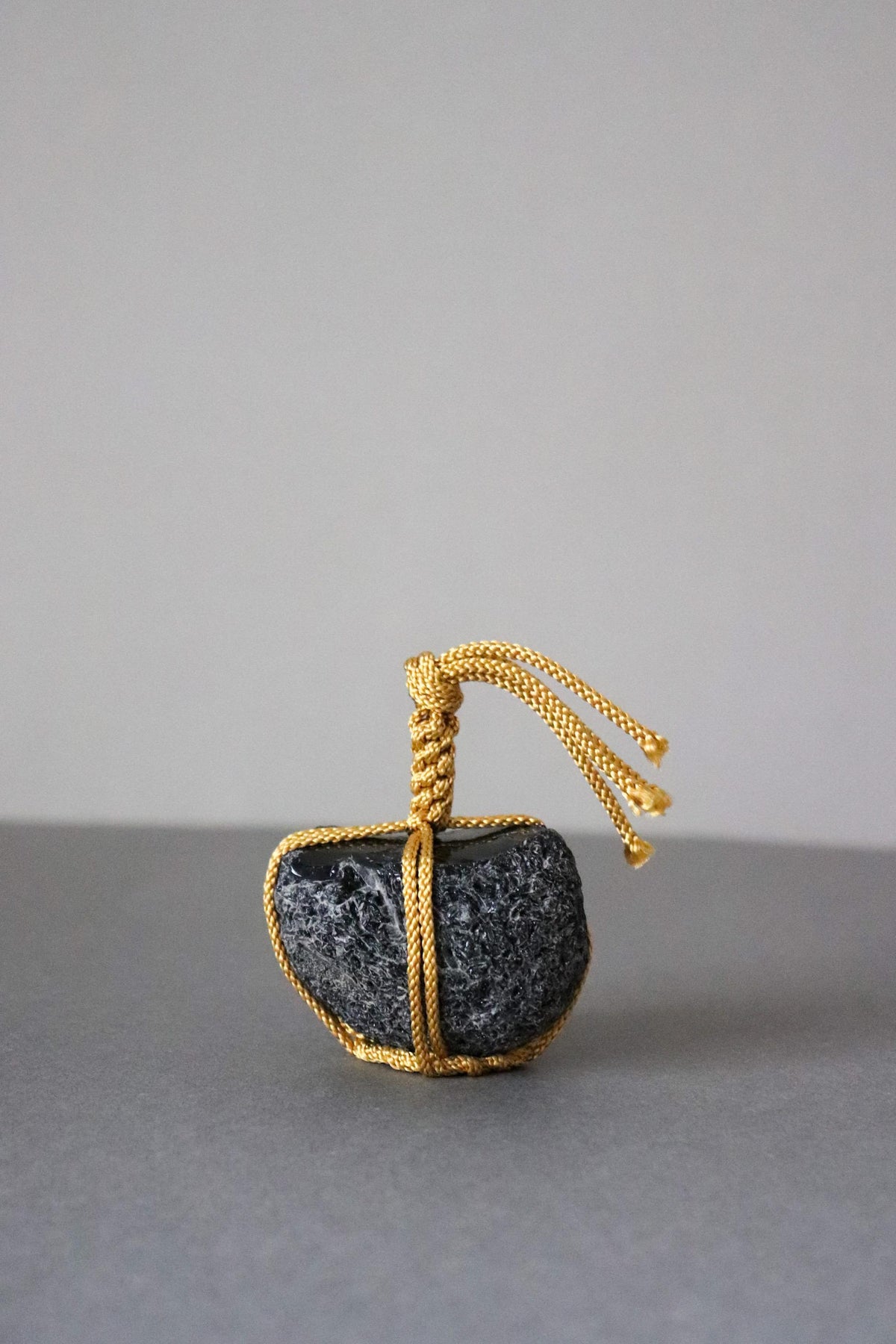
This Japanese Sekimori-ishi is made from natural obsidian from Hokkaido, Japan, and finished with a braided cord.
What makes this particular stone especially distinctive is its exposed fractured surface. The break reveals the dark, glass-like character of natural obsidian, catching the light differently from the rougher outer surface of the stone.
Rather than hiding this natural irregularity, the cord has been arranged around the stone so that its contrasting textures remain visible.
THE MEANING OF SEKIMORI-ISHI
Sekimori-ishi has long been used in Japanese gardens and tea spaces as a subtle sign meaning “Please do not enter beyond this point.”
Rather than using a fence, rope, or written notice, a single stone placed along a path quietly communicates a boundary.
It reflects a distinctly Japanese approach to space, expressing intention through a small gesture rather than an explicit instruction.
Traditionally found in tea gardens and along garden paths, today a Sekimori stone can also be appreciated as a sculptural object that brings a sense of stillness and intention into a space.
HOKKAIDO OBSIDIAN
The stone used for this piece is natural obsidian from Hokkaido, Japan.
Obsidian is a natural volcanic glass created when molten volcanic material cools so rapidly that crystals have little time to form, producing its characteristic dark, glass-like appearance.
In this particular stone, part of the obsidian has fractured, exposing a naturally reflective glassy surface. This creates a striking contrast between the rough exterior and the darker, subtly shimmering interior.
Hokkaido is home to some of Japan’s most important sources of obsidian, including the Shirataki area, known as Japan’s largest obsidian source.
The relationship between people and Hokkaido obsidian stretches back thousands of years. Archaeological evidence shows that obsidian from Shirataki was worked into stone tools during the Paleolithic period and transported over considerable distances across Hokkaido.
This piece is identified as Hokkaido obsidian and is not represented as specifically originating from Shirataki.
BRAIDED CORD
The natural volcanic stone is wrapped with a braided cord.
The warm tone of the cord contrasts beautifully with the black obsidian and emphasizes the irregular silhouette of the stone.
SIZE
Stone width: approx. 7 cm / 2.76 in
Overall height including cord: approx. 8 cm / 3.15 in
Material: Natural Hokkaido obsidian, braided cord
Made in Japan
HOW TO DISPLAY
Traditionally, Sekimori-ishi is placed along a garden path or at the entrance to an area where guests are gently asked not to proceed.
Today it can also be displayed in a Japanese garden, tea room, entryway, shelf, tabletop, or other quiet interior space.
It works beautifully as a wabi-sabi or Japandi interior object, a symbolic boundary marker, or simply as a distinctive Japanese sculptural object.
PLEASE NOTE
This piece is made using natural stone.
The exposed fractured area is part of the natural character and form of this particular obsidian stone. Natural cavities, irregularities, rough areas, variations in texture, and coloration are characteristics of the material and are not considered defects.
This is a one-of-a-kind piece. The photographs show the actual Sekimori-ishi you will receive.
Share